Sunday, 7 February 2010

Research for Thriller Openings - Criminal Justice - Jess D'Alvarez

Criminal Justice is an example of a thriller opening which uses the enigma code and restricted narrative many times as it raises many questions because information is kept from the audience and makes them wonder and question.

Opening Credits:

  • Slow, quiet, peaceful music, violins possibly. Not usual of a thriller, yet effective music.
  • Simple yet interesting typography, words merge into different words
  • Music begins at start of opening sequence and then gets louder for opening credits
  • Constant image of woman in background, she looks distressed. Who is she?
  • I relate the music to sadness. Do they want us to feel sad for the women in the background?
  • Music gets louder towards the end of the credits, this builds suspense as we think that something happens, then music carries on into shot after credits, but stops completely when woman slams door, so that we now focus on the woman and what she is doing.

Main Characters: (Do not know names)

Woman:
  • Aged around late 30's, mid 40's
  • Wearing plain coloured clothes, beige, grey, brown. These colours are very simple, plain and boring. This indicates that she could be non-adventurous with what she wears, shes careful.
  • Looks very tired, stressed, worried, upset and we do not know why.
  • In a rush? She rushes to get he coat on, where is she going? Has she done something wrong?

Man (Barrister):

  • Aged around late 30's, mid 40's, possibly late 40's
  • Doing his job, wearing his uniform. From the setting and his uniform we can see that he is a barrister.
  • Is he related to the woman? We do not know this yet.
  • Finishes job and changes into jogging suit, a hobby? keeping fit?

Enigma Code:

  • This opening sequence raises many, many questions in the minds of the audience. When shown shots of the woman questions such as: - Who is she? Is she related to the barrister? Is she a victim? Why is she so upset? Why is she in a rush? Is she a protagonist or antagonist? are raised, but not answered as yet.
  • Questions about the man are also raised examples are: - Is he related to the woman? Is he a protagonist? This looks likely because he is a barrister, sending someone to prison, so he would be a hero to the victims family, therefore the man in the docks could possibly be the antagonist.

Restricted Narrative:

  • The opening sequence raises many questions, therefore as an audience we are not being told many things and this is an example of restricted narrative.
  • We do not know who the woman is, she may be a victim, she may be a criminal. Therefore this creates intrigue for the audience and also creates suspense because we want to find out the answers to these questions.
  • 'What is the character of this killing? Vicious, brutal, frenzied' The audience does not know who has been killed or whether they are related to any of the main characters in this opening sequence, which again creates intrigue as to who has been murdered.

Camerawork:

  • In this opening sequence, the shots move from the woman to the man, this is not to create suspense, which would be typical of a thriller, however, this again raises the question, in the audiences mind, as to whether the two characters are related?
  • The woman is not revealed straight away, there are many close ups shown of the woman, however they are only of parts of her face or body, which raises questions in the audiences minds as to who the woman is. (See pictures below)

  • Low angles are used in order to make the male character seem more powerful and dominant. This is a typical stereotype of a male character and very typical of a thriller. This links in with the mans job, which is typically seen to be one of prestige and importance.

Iconography:

  • Typical of a thriller, there is usually signs of police, blood, weapons, dark places etc, however in this opening sequence, although there is no physical evidence of, police, blood, weapons etc, the audience know that there have been police and there has been the use of weapons and blood because of the fact that we are watching the court case for a murder. Blood, weapons, police etc are linked with murders.
  • The title of this thriller is 'Criminal Justice'. The word 'Criminal' suggests that there may be further crimes and therefore the audience can expect police, blood and weapons etc.

I think the narrative in this tv thriller begins as it does in order to raise questions in the audiences minds, to 'hook' them and keep them interested in watching the rest of the programme. In a way I think this comforms to the classic structure of a thriller because it creates suspense for the audience as they want to know what is going to happen next.

Research for Thriller Openings - Seven - Jess D'Alvarez

Opening Credits: The opening credits seem to introduce us to what the film is going to be about.

  • Typography. Very plain, simple. White writing on black background, however writing is somewhat scratchy, what does this reflect?
  • Shows shot of two hands. Even though this is in the opening credit, enigma code is already used as this shot of the two hands already starts to raise questions in the viewers' minds, as to whose they are? Do they relate to anything? etc.
  • Scraping off someones fingerprints. Seems to be something that a criminal would do, so we would relate this film to crimes, criminals, police etc.
  • Personally I think that all the things shown in the credits seem to relate to a criminal possibly trying to cover up a crime or possibly trying to choose their victims as their are pictures of some people.
  • The background music is very technical, kind of futuristic. It starts off slow and quiet however when it gets nearer to the end of the credits the music gets faster and louder.
  • There is a line at the end of the credits which I think says 'You've got the closer to God', if this is correct then this indicates that the film may have something to do with religion and belief.
Main Characters:

Detective Somerset (Morgan Freeman):


  • Old, leaving the job soon, but we don't know why.
  • Alone
  • Precise and organised. Suit laid on bed, very precise in the way he picked fluff off of his suit, also very precise in the way he picked his things up, they seemed to be in some kind of order. The way he picked them up looked very routine, like he did the same every morning.
  • Intellectual, chess board in first shot, reading a hardback book before bed.
  • Seems superior and experienced in his job. In one shot Detective Mills gets coffee for the both of them, seems that Detective Somerset has told him to do so, possibly.
  • Smart dress sense, takes pride in his apperance, wants to look smart for his job. Takes a while to do his tie up, wears a very crisp collared shirt.

Detective Mills (Brad Pitt):


  • Young, 30's maybe. However we know he has been a police officer for a while because he says 'I've worked homicides for 5 years' so maybe he started out relatively young.
  • Casual dress sense. He wears shirt and tie, however not as smart as Detective Somerset.
  • Arrogant, cocky, chews gum. The fact that he was chewing gum could show that he is laid back and possibly confident in his job.
  • Energetic, could be because he is young. In one shot he runs up some stairs, to meet Detective Somerset, was he late? or in a rush? or just energetic? This we do not know.

The First Murder:

This shot is shown after we have been introduced to the two main characters.

This shot is a very good example of how enigma code is created. In this shot alone there is a typical feature of mise en scene, usually found in a thriller, and that is blood. When the audience sees this shot, the dead body and the blood, many questions are raised such as, who is that? what happened? how did it happen? why did it happen? who killed them? etc. The use of blood is also iconography, because blood is a typical feature in a thriller.

  • Restricted Narration is also used in the opening sequence of this film because the audience do not know where the body is as we have not been told. I think that it could possibly be a warehouse however I do not know this for sure.
  • Restricted Narration is used again when one of the detective's is on the phone and we, the audience, are not told who was on the phone or what was being spoken about. This again raises questions, enigma code, in the audiences' minds.
  • I found this thriller opening very effective.
  • The editing of the opening credits is amazing and the music makes them even better.
  • If I were to choose something that I would like to use in my thriller opening, it would probably be the typography and the way on which it appears on screen, in a jumpy/static kind of way.

The Simpsons - Cape Feare - Jess D'Alvarez

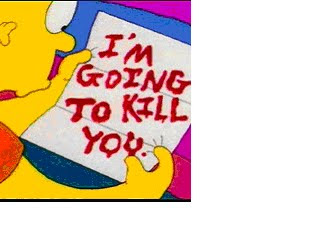
Restricted Narrative is used in this episode of The Simpsons because the audience do not know why Sideshow Bob wants to kill Bart, therefore the audience are left to make up their own story as to why they think Sideshow Bob wants to kill Bart.

This is a good over the shoulder shot because you can see what Bart is reading and you can also see some of his facial expression, which is that he looks scared because of the letter he has just received. The writing is written in red, which is instantly thought to be blood because of what is written on the letter and due to the effect of the blood dripping, that we can see from this picture.


This is a long shot, 2-shot because you can see the whole of the characters bodies. The lighting in this shot is interesting as the opened door seems to have cast a shadow on the wall, which makes the shot seem darker and scarier, this is an example of low key lighting. Bart looks terrified and you can see this by looking at the position he is standing in and how he is clutching his bed covers and wanting to pull them over himself to hide. Typically, in a thriller, there is a weapon, which seems to me a knife in this picture, however the weapon changes throughout the programme.


In this shot the weapon changes to a sword. Again Sideshow Bob's expression in this shot is very angry, however the audience still doesn't know why he wants to kill Bart. From this shot you can tell that it is set at night, which makes it seem scarier because there is no one around to save Bart from being killed.


I think this is a fantastic shot and shows Barts facial expression extremely well. It shows that he is terrified of what might happen to him and I think that the way his hands are positioned shows that he just wants to pull the cover over him and for everything to go away.


  • In one particular shot Bart was standing behind the bars of a climbing frame. At first the audience only see Bart behind the bars, which raises questions as to why Bart is behind bars? What has he done wrong? This is an example of enigma code because it raises questions in the viewers' minds. However the whole of the shot is then revealed and the audience find out that he was in fact behind a climbing frame.
  • In another shot, the camera moves from a birds eye view of The Simpson house to a birds eye view of the prison, of which the audience know that Sideshow Bob is currently at, this shows that the two characters are near and again raises questions in the viewers' minds of what will happen.
  • When it moved to the shot of the prison, thunder and lightening appeared, which reinforces the idea that prison is a bad place and thunder and lightening are usually associated with bad things.

Wallace and Gromit - A Close Shave - Jess D'Alvarez

Most people would not class Wallace and Gromit - A Close Shave as a thriller, however in this short film there are many aspects which make it a thriller. But what is a thriller? A thriller is a suspenseful story, play or movie.

•In the opening of this short film suspense is created by dark lighting and a rather scary prop, which happens to be a cheese knife.
•Urban setting. I think this because there is a lot of traffic noise coming from outside and the noise of a lorry driving past the house, which happens to make the house shake along with the contents of the home.
•This is then when the knife (picture below) falls from the bedside cabinet and into the floorboards.
•Movements of this knife, from the bedside cabinet to the floorboards, and the power at which the knife stuck into the floorboards makes the knife, even though it is a cheese knife, seem like more of a dangerous weapon and creates suspense for the audience as they may start to create a story in their heads. The sound effects that are used for the movement of the knife, make it seem more terrifying.

The lighting in this is very interesting because it is very dark, all apart from one bit, which seems to illuminate the knife. I think that the bit of lighting that is behind the titles, is meant to be that of the moon, which to me makes the opening sequence creepier and more like a thriller because when I think of moonlight I instantly think of werewolves, which I link to thrillers.


Interesting Shots:

I think the low angle was used to make Preston seem more scary and intimidating. The use of clothing, the collar Preston is wearing, shows that he is not an innocent and 'normal' dog because the spikes seem to be portrayed as something harmful, therefore portraying Preston to be harmful or 'evil'.


This shot is also a slightly low angle and makes Preston look bigger and scarier than in the previous photo. It is dark behind Preston which makes Preston stand out. The light shining on Preston also makes him stand out more. This shot is a mid close up and clearly shows the facial expression and body language of Preston. This shot is used to indicate that he is a somewhat evil.


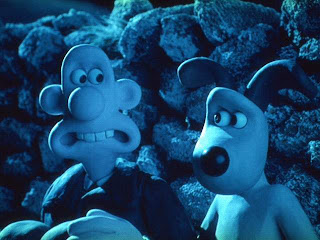
I particularly like this shot as it shows the expression on both characters faces very well. This shot is vital in order for the audience to understand how the two characters are feeling at this particular time. There is a slight glow on both of the characters which shows that there might be a source of natural lighting, such as the moon, however because this is an animation we know that it is not natural lighting, but from this we can tell that this shot is at night.


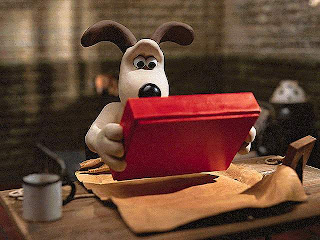
This shot is a long shot at eye level. From this shot alone you can tell that Gromit is in some kind of solitary confinement because everything is very minimal. This shot shows Gromit's body language and facial expression very clearly and from this shot you can see that Gromit is somewhat sad. Restricted narrative is used in this shot because we, the audience, cannot see what package Gromit is holding, therefore it creates tension and intrigue.

Thursday, 4 February 2010

Ed Boyce- Thriller opening research

Thriller films that Ive chosen to look at and research:
  • The Dark Knight
  • One Hour Photo
  • Seven
  • Memento
  • The Matrix


The Dark Knight


The Dark Knight opening scene: http://www.youtube.com/watch?v=Y1YF9ZuVD-w&feature=related

Mise en scene:

At the beginning of the film we have an establishing shot. The location is that of a typical urban city. Urban areas are usually used for thrillers. The camera switches to a one of the buildings windows being smashed by a harpoon type of gun, this adds suspense.
The setting then changes to inside a bank.

We also see men carrying guns which is a standard prop in many thrillers, this represents iconography.
We cannot see any facial expressions in this opening scene as all the men wear masks. The fact that they are wearing masks suggests that they are going to commit a crime.

Camera Work
The first shot we see is a high angle establishing shot which sets the scene well for the audience.

Sound
The sound used in this opening scene is what you would expect to find in a thriller. The music is suspense building which then quickens in the action scenes.

Why it's a good thriller

Enigma code is used in the opening scene. This starts when we see the men with masks on, this raises the question as to why they are wearing masks. It becomes clear that they are going to rob the bank, but then we see one of the robbers killing other robbers. This again raises the question as to what the intention of this robber is. Thrillers are usually filled with plots twists to confuse and shock the audience. As a opening this strange turn of events intices the watcher to find out and watch on. As we are introduced to the strange 'joker' character this is enhanced because of his strange make up and personality. The cunning plots in the film make it a great thriller in my opinion.
--------------------------------------------------------------------------------------


One Hour Photo


What sort of person is the main character?
  • The main character seems to be a 'normal person'. His clothing is normal and his haircut as well, nothing stands out to us through mise en scene in this form.
  • As for personality he seems calm, although this could be misleading as he is being interviewed by a detective in a police station.
  • It seems strange for a 'normal, calm' person like this to be in that situation therefore i think there is something strange about him. He also asks a rather random question about if they have their own lab, which again makes us think why he would say this.
How do you feel about the main character?
  • I feel sorry for the main character. He seems very confused and not thinking straight. This is portraited when he turns the wrong way when asked to.
  • I also feel sorry for him because he is isolated. The long shot we are given of him sitting in the interview room on his own isolates him behind the desk. Also the colour of the walls is plain white and he stands out in the middle of the shot.
Analyse the opening credits
  • This film is a Thriller and the opening credits portrait this. The background is black with small text in the middle. The sound we here is a sinister music, with deep pulses of bass in time with a light flashing behind the text. I think the reason for them to do this is because it is a thriller, the music sets suspense. I think the light flashing behind the text is relevant to the title 'One Hour Photo' as it is flashing like a camera.
The setting
  • The setting sets a serious tone to the film. The first shot we see is in as police station, the atmosphere that this creates
The flashback
  • The way that mise en scene is used here in the main characters facial expression. It is a blank, still expression that gives us the idea that he is thinking. Music then fades into this shot, starting quietly and getting louder given the audience the sense that we are going somewhere.
  • Editing has been used to slowdown the footage we see in the flash back. This gives us the sense that it is not the present. Also we can hear the main characters voice while we here the sounds of the characters in the flashback.
Atmospheres of the two places
  • The police station is very quiet, we can hear every little sound that occurs such as footsteps. This is a big contrast to the garden, which is alive with the sound of lots of people.
  • The setting is very different as well because of the colours used. The garden is green with bright colours, green represents life and the happiness in the garden. The police station is bare white again giving us that very sense of seriousness.
--------------------------------------------------------------------------------------


Seven


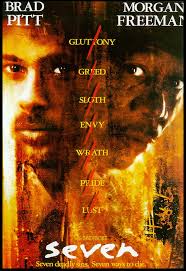
Seven (stylized as Se7en) is a 1995 American crime film directed by David Fincher and written by Andrew Kevin Walker. The story follows a retiring detective (Morgan Freeman) and his replacement (Bradd Pitt), jointly investigating a series of ritualistic murders inspired by the seven deadly sins.

Opening Credits
The opening credits to Seven are very unique and some of the best.
  • We first see white writing on a back ground, which is pretty standard however the writing is scratchy and sinister.
  • We see someone scraping off there finger prints, this indicates us that someone is going to commit a crime. This raises questions to us who and why.
  • This credits are quite disorientating, there is a lot of flashes and in general they are very crude and sinister.

Characters
Detective Mills - (Brad Pitt)
  • Casually dressed when compared to Detective Summerset. He wears a shirt and tie but it is crumpled and doesn't sit in a neat fashion.
  • Young, probably early 30s.
  • Arrogant. I get this impression from the way he chews his chewing gum with and open mouth. Also when bumped into in the street he seems to want a confrontation suggesting he is cocky.
  • He runs up the stairs we get the impression that he is energetic or just last. He is not as precise as Detective Summerset, who we would not see run up the stairs.
Detective Summerset - (Morgan Freeman)
  • Old and wise. Been in the job a long time and is a veteran.
  • Very different to Detective Mills. He is very precise and organized. We see him wake up on time and his items are prepared the night before. He does the same routine each day.
  • Seems to look down on Detective Mills, probably because he is new to the area and Summerset is a master in the area.
  • We also get the impression he is very intelligent, as we see him reading a hardback book and a chessboard at the start. Both are seen as intellectual items.


  • This is the first murder we are shown. Murder is something you would expect in a thriller as it creates the drama.
  • The first murder is thrust upon us and it is surprising. This is a good example of enigma code as it makes us start to question why this happened, who the killer was etc.
  • We also see blood here which is iconography as this is something typically in thrillers.
I personally thought this was a very good thriller opening. The Murder we see instantly lets us know that there is killer on the lose and you want to find out who did it and why. The opening credits are also very intriguing and really set the scene for a crime thriller.
--------------------------------------------------------------------------------------

Memento


Memento opening scene: http://www.youtube.com/watch?v=TR5qO9yyQUg
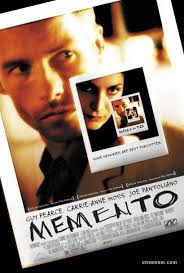
The Memento opening scene is very intrigueing. It starts with a hand holding a picture. The picture shows a gory image. The hand shakes the picture and it fades which makes us wonder whats happen. It then becomes clear that time is in reverse. It then clicks in that we are about to witness what that picture showed, this is a great suspense builder and a unique technique.

  • We then see the murder take place. This shot includes blood, guns-icongraphy.
Enigma codes
  • Why did this murder take place?
  • Why show it in this time order?
  • Why take a picture of it?
These things bring questions to our minds as to why the opening is presented this way.

There is also a scene in this opening of the main character in a hotel room. It is in black in white,the reason i think this was done was to show his confusion as he is thinking.

Sound
The music at trhe beggining of the scene is sorrowful. It sets the tone of the movie.

Mise en scene
  • The location is urban like most thrillers
  • The location in the film changes to a more deserted house with low key lighting, where the murder takes place.
  • The characters are normally dressed.
I think this is a great thriller opening. The reversed time technique is a great suspense builder and quite different from any other films. It really plays with you mind and lets you into the complex plot of the film.
--------------------------------------------------------------------------------------


The Matrix


http://www.youtube.com/watch?v=8pBmM9R80_A


  • In the openoing credits we see strange green writing/codes/numbers , its hard to make out what this is and its purpose, but with the sound effects it sounds like something futuristic.
  • The green text on black background is something military like.
  • We then see police holding guns (iconography), the lighting is very dark and it sets the mood at the thriller, because they obviously want to shoot someone for some reason.


Enigma Codes
  • Who are the police trying to arrest/kill?
  • We wonder who this women is and who are the people chasing her?
  • Why are they chasing her, why is she so wanted?
The build up before opening the door adds suspense that is relieved in a high action chase scene.


Ed Boyce

Research for Thriller Openings - One Hour Photo - Mathew Garrett

The main character


  • When we are introduced to the Male character we see that he is most likely in his late forties


  • His hair is short and fair. He is also going bald so he has his hair swept to one side of his head


  • His clothes are pale and do not stand out which suggests that he doesn't want to draw any unwanted attention to himself


  • He holds himself in a slightly hunched manor


  • He looks quite calm but also nervous. His eyes look sagged and sad as if he knows he has done something wrong


  • The computer monitor says "threat" at the top of his Police profile picture which tells us, the audience, that he actually has done something wrong and that he could be a danger to others


  • From when we are first introduced to the male character we see cameras


  • When he is in the questioning room, he asks about the development of the pictures needed by the police department which suggests that he has an interest in photography


  • The pictures that are laid down in front of him are evidence and he also wants to see them which again tells us that he has an interest in photography


  • I think the audience is supposed to feel sadness for this character but also we are meant to know that he has done something bad and that he isn't really that innocent


Opening credits


  • When the credits appear on the screen they are shown to represent images being put through a photo developer and being exposed to light then processed


  • This could mean that the film is about photography and after the credits we find out that photography is a big part of this sequence


  • I could also hear the sound of machinery in the background which also made me think it was representing a developer


  • By creating the credits this way we are introduced to the set up of the film immediately and we know that the story could be about photography


Setting


  • The first shot made me think that the set was supposed to be camera lab of some sort, because of the big camera and the noises of what sounded like the developing machinery from the opening credits


  • The sound before the shot is taken was load bass and suspenseful


  • Once the photo is taken the shot reveals a police station and that this character is having his "mug" shots taken


  • The computer set up suggests that they are not as technologically advanced as other computer systems to date but they are all that they had at the time


  • The room we see the character in next appears to be some sort of questioning room which is usually common to a thriller film. The iconography of it is recognized in nearly all thriller films and t.v shows


  • the room looks secure and isolated suggesting that it may not be intended for the nicest of people


  • As the camera pushes in from an office to the questioning room we see the character from a high angle shot which is used to create smallness towards the character and we are supposed to think less of him, rather than a normal shot which wouldn't make us think about it as much


Flashback


  • The flashback

Research for Thriller Openings - One Hour Photo - Jess D'Alvarez

The Main Character:

  • Has short, blonde hair, wears glasses, looks around 50's which if you read this description you would think that he was a 'normal' person.
  • He is wearing plain coloured clothes, very minimal which also indicates that he is just like any other person and that he is 'normal'.
  • He seems very calm whilst in the interview room, almost as if he doesn't think he has done anything wrong, but he must've otherwise he wouldn't be at the police station.
  • I feel that, if the character is guilty of a crime, he didn't mean to commit the crime. From the questions he was asking the police detective such as: 'Do you have your own lab?', which are general questions, but ones that you wouldn't really ask a police detective, I get the impression that there might be something wrong with the character, maybe a mental illness?
Opening Credits:

  • The opening credits were accompanied by rather haunting music.
  • Movements represent those of a photo be developed, starts to build up the theme of the film.
  • Sounds to match those of a photo developer were used to match the action and make it seem more real.
  • I found that there was also a noise that I heard that I think could've represented a heartbeat.
  • At the end of the opening credits, the title 'One Hour Photo' was illuminated in many different colours.


The Setting:

Interview Room:

Bright, white, very minimalist room with one table and two chairs.

From the above description you can tell that it is an interview room as interview rooms are usually seen to be very plain, boring and minimalist and that is all they really need to be.

Garden:

  • Very bright, distinct colours: green, yellow, red.
  • Everyone looked happy, smiling
  • Children were talking, playing and laughing, just having a good time.
  • There was music that played whilst the garden scene was showing and this music was happy music. It makes the audience feel joyful. However the children's laughter, at times, overpowered this music, which I think was used to make the audience feel happy and make the atmosphere of this particular sequence happy.
  • Camera focuses on a young boy, man and women. This makes the audience wonder who they are. I think that the young boy could be the main character as a child and his parents or that the young boy could in fact be the main characters victim, if he has committed a crime.

This is a close up, group shot, of the scene in the garden. The boy, seems to be the birthday boy, and his parents look very happy. Makes the atmosphere of the garden scene happy and different to the scene of the man in the interview room.


Camerawork:
  • At the beginning of the opening sequence there is a big close up of a camera. The video camera then focuses on that camera and as the music starts to build up, the flash of the camera goes off. The music builds up to the flash and in some way makes the audience jump because they do know what to expect, well at first it made me jump. Then shows the picture that the camera has taken.
  • Before the flashback, the camera focuses on the main character. I think this is done to show that he is trying to remember something from his past. As well as this, music begins to get louder and louder, building up to the flashback.